Break-Even Rent: How to Calculate the Minimum Rent a Property Needs

Break-even rent is the monthly rent at which a rental property earns exactly $0 after every cost: vacancy, operating expenses, reserves and the mortgage payment. Collect less and you pay to own the property. Collect more and the difference is your cash flow. The formula is simple. The mistakes come from leaving costs out, so the number looks lower than it really is. Our free rental calculator runs the numbers with no sign-up.
TL;DR
- Break-even rent = (fixed monthly costs + mortgage payment) ÷ (1 − vacancy rate − percentage-based costs such as management).
- Include capital reserves and vacancy. Leaving them out is the most common way to understate break-even rent.
- Compare the result with at least three recent, similar local leases. If market rent does not clear break-even with a cushion, the deal does not work at that price.
- Rerun the number at a higher interest rate, higher vacancy and higher insurance before you offer.
Table of Contents
- What break-even rent actually measures
- The break-even rent formula
- Worked example: a $250,000 single-family rental
- Costs that quietly move the number
- How to check break-even rent against the market
- Stress-test the result before you offer
- Common break-even rent mistakes
- Where break-even rent fits in a full deal analysis
- Run it with our rental calculator
- Our perspective
- FAQ
- Sources
What break-even rent actually measures
Think of a rental as a small business. Break-even rent is the revenue that business needs just to cover its bills. Everything above it is profit, and everything below it comes out of your pocket.
The term sits next to a few related measures that investors and lenders use. They are easy to confuse, so here is how each one differs:
- Break-even rent is a dollar figure per month (or per square foot): the rent you need.
- Break-even occupancy is a percentage: how full the property must be to cover costs. The National Apartment Association defines the Breakeven Occupancy Ratio as operating expenses plus debt service plus replacement reserves, divided by effective gross income. It defines break-even rent per square foot the same way, with total property square feet as the divisor.
- Break-even ratio is the lender’s version. The Office of the Comptroller of the Currency’s income-property lending handbook describes it as operating expenses plus debt service, divided by gross income, with a lower ratio meaning more cushion and less risk for the lender.
- DSCR (debt service coverage ratio) compares net operating income to the loan payment. CREFC’s underwriting principles note that a DSCR of 1.0x means cash flow exactly covers the contractual debt payment, and that higher is safer.
For a single-family rental or a small multifamily, break-even rent in dollars is the most useful of the four. It tells you what to look for on the rent listings before you ever make an offer.
The break-even rent formula
Start with the costs that do not change with rent, then adjust for the ones that do.
Step 1: Add up fixed monthly costs. These are property taxes, insurance, repairs and maintenance, capital reserves, owner-paid utilities, HOA dues, lawn or snow care and anything else you pay regardless of what the tenant pays you.
Step 2: Add the monthly mortgage payment. Use principal and interest, plus escrow only if you have not already counted taxes and insurance in step 1. Do not count both.
Step 3: Account for costs that scale with rent. Vacancy and property management are percentages of rent, so they cannot be added as flat dollars until you know the rent. You solve for them instead.
Step 4: Solve for rent.
Break-even rent = (fixed monthly costs + mortgage payment) ÷ (1 − vacancy % × … adjusted for management %)
In plain terms, if you lose 5% to vacancy and pay management 8% of what you collect, you keep about 87.4 cents of every scheduled rent dollar (0.95 collected, less 8% of that for management). Divide your total monthly costs by that 0.874.
The division step is where people slip. Adding 5% to the total cost is not the same as dividing by 0.95, because the vacancy applies to the rent you are solving for, not to your costs.

Worked example: a $250,000 single-family rental
This is an illustration with round assumptions, not a quote for any market. Swap in your own numbers.
Purchase and loan
- Price: $250,000
- Down payment: 20% ($50,000)
- Loan: $200,000 at 7% for 30 years
- Principal and interest: about $1,331 per month
Fixed monthly costs
| Cost | Monthly |
|---|---|
| Property taxes ($3,000 per year) | $250 |
| Insurance ($1,800 per year) | $150 |
| Repairs and maintenance | $100 |
| Capital reserve (roof, HVAC, water heater) | $100 |
| Fixed total | $600 |
Total to cover before rent-based costs: $600 + $1,331 = $1,931 per month.
Rent-based costs: 5% vacancy and 8% management on collected rent. You keep 0.874 of each scheduled rent dollar.

Break-even rent: $1,931 ÷ 0.874 = about $2,209 per month.
Now test it against the market:
- If comparable homes rent for $2,350, you keep $2,054 after vacancy and management. Subtract the $1,931 in costs and cash flow is about +$123 per month.
- If they rent for $2,100, you keep $1,835. Cash flow is about −$96 per month.
Same property, same loan, a $250 difference in rent, and the deal flips from slightly positive to slightly negative. That is why the break-even number matters more than a rule of thumb.
The same deal as a break-even occupancy check
At $2,350 scheduled rent, annual rent is $28,200. Operating costs are $7,200 in fixed items plus management of roughly $2,256, or $9,456. Add $15,972 in annual mortgage payments and you reach $25,428. Divided by $28,200, that is about 90%. In lender terms, rent can fall roughly 10% before cash flow reaches zero. A lower percentage means a bigger cushion.
Costs that quietly move the number
The formula is only as honest as the list of costs feeding it. These are the ones first-time investors most often miss.
Capital reserves
Roofs, furnaces, water heaters and flooring wear out on a schedule. A reserve spreads those big, predictable bills into a monthly line item. In the example above, dropping the $100 reserve cuts break-even rent from about $2,209 to about $2,095. That looks like a better deal, but the cost has only been moved to a year when the roof fails.
The NAA’s definition of the breakeven ratios explicitly includes replacement reserves in the numerator, so skipping them departs from the standard formula.
Vacancy and turnover
No property is rented 365 days a year. Vacancy is the rent you do not collect between tenants. Turnover adds cleaning, paint, small repairs and marketing. Use a vacancy figure based on your submarket, not a hopeful one. When in doubt, run the calculation at two vacancy rates and see how far break-even rent moves.
Taxes and insurance
These vary widely by state and even by neighborhood. They are also the two lines most likely to jump after you buy, since a purchase can trigger a reassessment in some places and insurance premiums reprice annually. If you invest in Florida, get an actual insurance quote for the specific address before you finalize the number, and check how the county assesses property after a sale. Do the same for any other state where you buy. Using the seller’s current tax bill is a frequent and expensive shortcut.
Management
Even if you plan to self-manage, put a management line in the math. It shows whether the deal still works if you hire help later or if your time is better spent elsewhere. It also keeps you from comparing your numbers with those of investors who do pay for management.
Debt: principal and interest only
Operating expenses do not include the mortgage. The loan payment is a separate line below net operating income. Mixing the two is how cap rate and cash flow calculations end up wrong. If your rate is not locked, price the loan at today’s rate and again at a higher one.
A 0.5-point rate difference matters. At 7.5% instead of 7%, the payment on the same $200,000 loan rises to about $1,398. Break-even rent rises to about $2,286, which is $77 per month more for the same house.
How to check break-even rent against the market
A break-even number means little until you compare it with what tenants actually pay. Use this process.
- Pull comparable rentals. The National Council of Housing Market Analysts says rent comparisons should use similar properties in location, age, condition, design, bedrooms, bathrooms and utilities, adjusting where they differ.
- Prefer signed leases to asking rents. Listings show what landlords hope for. Recent lease rates show what tenants accepted.
- Narrow the range. The same guidance recommends checking whether adjusted comps tighten the range and identifying outliers. One unusually high rent should not set your assumption.
- Adjust honestly. If your property has no garage and the comps do, lower the rent. If the comps were fully renovated and yours has dated finishes, lower it again.
- Pick a conservative rent. Use the middle or lower end of the adjusted range, not the top.
- Compare to break-even. You want market rent to clear break-even rent with room to spare. How much room is your call, but a property that only works at the top of the range has no margin for a bad month.
The gap between break-even rent and conservative market rent is your monthly margin. It pays for surprises: a slow lease-up, a repair bigger than your reserve, a tax bill that came in higher than expected.
Stress-test the result before you offer
A single break-even number gives a false sense of precision. Run three more versions:
| Scenario | What changes | What to watch |
|---|---|---|
| Higher rate | +0.5 to +1 point on the loan | Break-even rent and DSCR |
| Higher vacancy | Double your vacancy assumption | Whether market rent still clears break-even |
| Cost shock | Insurance and taxes up meaningfully | Fixed costs and monthly margin |
The OCC handbook describes the same logic for lenders: verify income and expense data, then see how higher vacancy, lower net operating income and higher debt payments affect the property. If a deal only works when everything goes right, you are speculating, not investing.
Our guide to the rental stress test walks through these scenarios with no-signup calculators.
Common break-even rent mistakes
- Using the seller’s expenses. Sellers understate repairs, reserves and taxes. Build your own list.
- Using asking rent as market rent. Check signed leases.
- Forgetting reserves. This is the biggest source of an artificially low break-even.
- Counting the mortgage twice. If escrow includes taxes and insurance, do not add them again.
- Applying vacancy to costs instead of rent. Divide by the share of rent you keep.
- Ignoring cash to close. Break-even rent covers monthly operations. It does not tell you how much cash you need on day one for the down payment, closing costs and initial repairs.
- Running one scenario. Run at least a base, a conservative and a worst case.
Where break-even rent fits in a full deal analysis
Break-even rent answers one question: what is the minimum? To judge whether a property is a good investment you also need cash flow, cap rate and cash-on-cash return. Our guide to analyzing a rental property covers cash flow, cap rate and the 1% rule. If you want the yield side, the rental yield calculation walkthrough takes you through it in six steps.
If you plan to buy a property that needs work, then renovate, rent and refinance, break-even rent changes after the refinance because your loan changes. Our refinance cash-out analysis shows the math to run, and the BRRRR method explained covers the full strategy. Always calculate break-even rent on the post-refinance payment, not the original hard-money or bridge loan.
For short-term rentals, the logic is the same but vacancy, cleaning, platform fees and utilities behave differently. See our short-term rental analysis article.
Run it with our rental calculator
Doing this on a spreadsheet works until you are comparing five properties at once. Our rental property calculator covers cash flow, cap rate and ROI, and the free tools need no sign-up. If you want to model the loan separately, the investment property financing calculator lets you test different rates and down payments.
When you are analyzing deals every week, the Real Estate Investor Toolkit plan is $39.99 per month. It includes unlimited reports, saved deal pipelines, advanced property data, owner-occupancy details and AI chat insights in one plan.
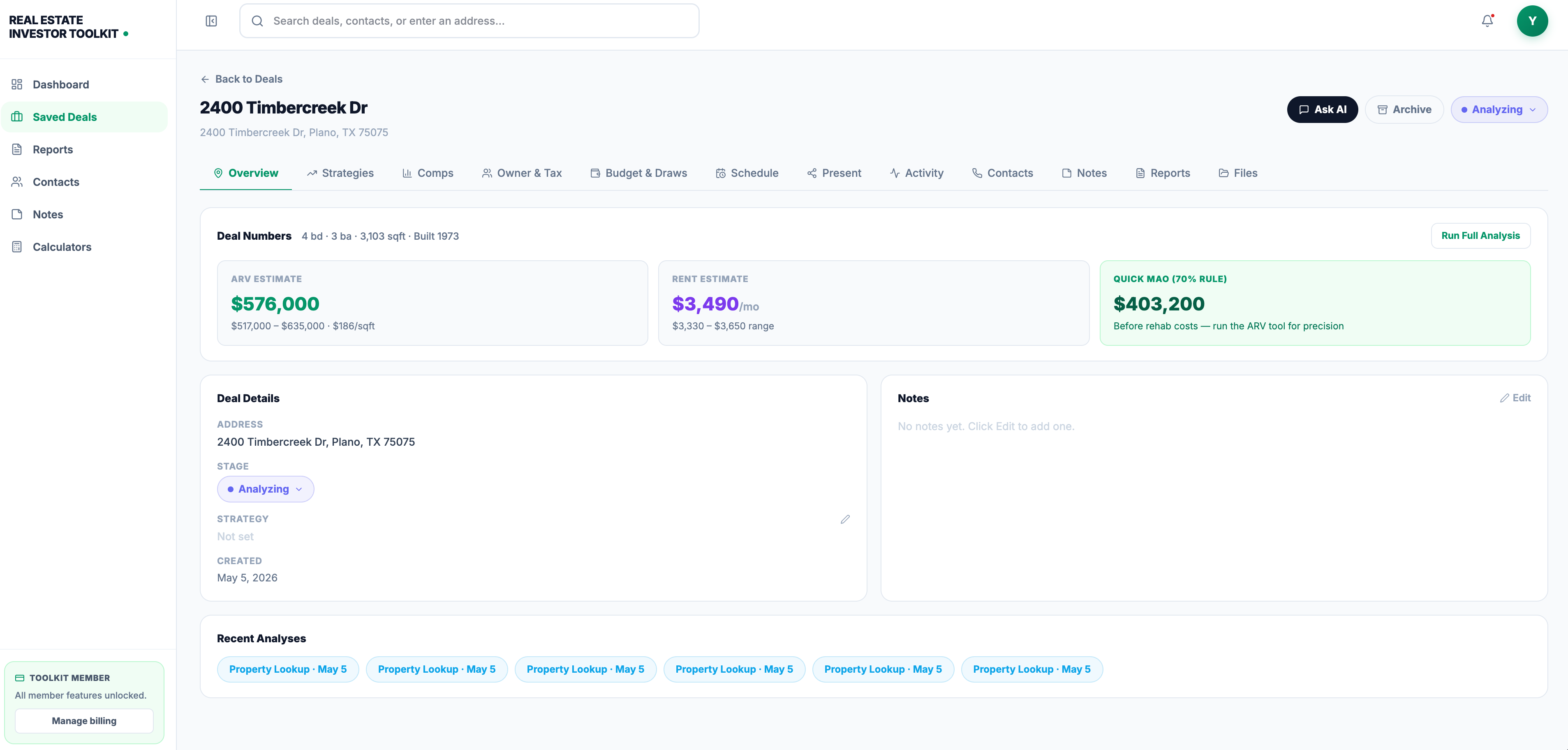
Start with the free tools, and upgrade only when you need to save and track deals.
Our perspective
Most break-even mistakes we see in the way investors think about deals come from the same place: they calculate the number once, on the best day, and treat it as fact. A break-even rent is an assumption set. Change the rate, the vacancy or the insurance quote and it moves.
That is why we built the toolkit around fast, repeatable analysis. When you can run a property in a few minutes without creating an account, you can run it five times with five different assumptions. You stop falling in love with one number.
Our approach to rental analysis is to put cash flow, financing and market data in one place. Investors who check break-even rent against verified market comparisons and a realistic cost list tend to make calmer offers. They know where their floor is before the seller starts negotiating.
If you take one habit from this article, make it this: always know the gap between your break-even rent and the conservative market rent. That gap is your margin of safety.
Michael
FAQ
What is a simple way to calculate break-even rent?
Add your fixed monthly costs (taxes, insurance, repairs, reserves, utilities) to your mortgage payment. Then divide by the share of rent you actually keep after vacancy and management. With 5% vacancy and 8% management, that share is about 87.4%. The result is the minimum scheduled rent that produces zero cash flow.
Is break-even rent the same as break-even occupancy?
No. Break-even rent is the dollar amount you need per month. Break-even occupancy is the percentage of the property that must be rented to cover costs. The National Apartment Association defines the occupancy ratio as operating expenses, debt service and replacement reserves divided by effective gross income. Both use the same cost inputs, so you can calculate them together.
What expenses should I include?
Include property taxes, insurance, repairs and maintenance, capital reserves, owner-paid utilities, HOA dues, management, lawn or snow care, turnover costs and the mortgage’s principal and interest. Add vacancy as a percentage of rent. Leaving out reserves or vacancy is what most often makes a deal look better than it is.
How much cushion should I want between break-even rent and market rent?
There is no single required number, and it depends on your risk tolerance, financing and market. Lenders think in similar terms: the OCC handbook says a lower break-even ratio means more cushion. A practical test is whether the property still breaks even after a higher rate, higher vacancy and higher insurance cost.
Does break-even rent include the down payment?
No. Break-even rent covers monthly operating costs and the loan payment. Your down payment, closing costs and initial repairs are one-time cash needs. You measure those against cash flow through cash-on-cash return, not through break-even rent.
Sources
- CAM Financial Terms and Formulas Quick Guide, National Apartment Association
- Examination Handbook 210 Appendix A, Income Property Lending, OCC
- NCHMA Guidelines for a Rent Comparability Study
- CREFC Principles-Based Underwriting Framework